
Most strategic planning fails because teams can't agree on what matters most — not because they lack intelligence or effort, but because the conversation has no structure that forces resolution. The SFAS matrix fixes that.
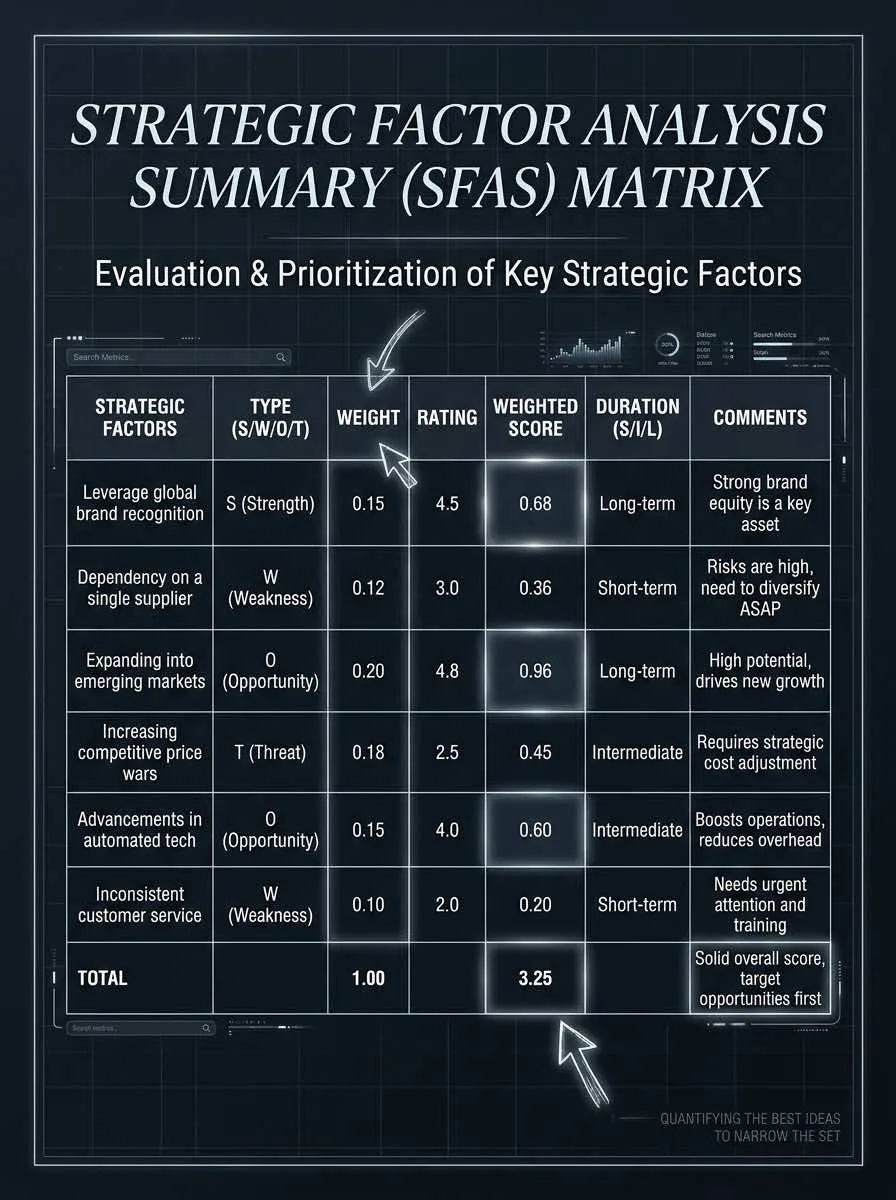
Strategic Factor Analysis Summary (SFAS) is a decision framework that converts abstract debates about priorities into concrete, defensible scores. It works because participants agree on the measurement criteria before scoring anything, which creates buy-in through co-creation rather than persuasion. For consultants working with directionless or misaligned teams, it's the difference between a meeting that ends with "we'll figure it out" and one that ends with a ranked list everyone can execute against.
The framework isn't complicated. You identify the factors that could drive success or failure in your situation. You define what "high impact" and "low impact" actually mean in your context. You score each factor against those definitions. You weight the scores based on what matters most to your specific goals. The output is a prioritized list that reflects collective judgment rather than whoever spoke loudest.
What makes SFAS different from every other prioritization exercise is that it separates the definition of the scale from the act of scoring. Most frameworks collapse those two steps, which means people argue about both the criteria and the ratings simultaneously. SFAS forces the group to agree on what a "5" means before anyone assigns a "5" to anything. That single structural choice eliminates most of the friction that kills strategic alignment.
The Structure That Makes Competing Priorities Navigable
The SFAS matrix organizes decision-making around four components: strategic factors, rating criteria, weighted scores, and total priority rankings. Each component serves a specific function in converting subjective judgment into shared measurement.
Strategic factors are the variables that could materially affect your outcome. In a manufacturing context, that might be inventory turns, lead times, supplier reliability, margin pressure, and workforce capacity. In a growth context, it might be customer acquisition cost, retention rate, product-market fit, and competitive positioning. The factors are domain-specific, but the principle is universal: you're naming the things that could move the needle, not the things you wish mattered or the things that are easy to measure.
Rating criteria define what the numbers mean. A "5" for impact might mean "directly affects revenue within 90 days." A "1" might mean "no measurable effect on core metrics this year." A "5" for feasibility might mean "we can execute this with current resources and no external dependencies." A "1" might mean "requires budget we don't have and capabilities we'd need to build from scratch." The criteria are co-created by the group before any scoring happens, which means everyone is working from the same definition of what the scale represents.
Weighted scores reflect the relative importance of different dimensions. Impact might carry a 70% weight if you're in a turnaround situation where results matter more than elegance. Feasibility might carry 60% if you're resource-constrained and can't afford to start things you can't finish. The weights are explicit, agreed upon in advance, and applied consistently across all factors. This prevents the common failure mode where people score factors based on their personal priorities rather than the group's stated goals.
Total priority rankings are the output — a sorted list that reflects both the individual scores and the agreed-upon weights. The ranking isn't a recommendation from the consultant. It's the mathematical result of the group's own judgments, applied through a structure they helped define. That's why it sticks. People don't argue with conclusions they participated in creating.
The SFAS matrix works because participants agree on the scale before scoring anything, which creates buy-in through co-creation rather than persuasion.
The Foundation: Factors and Criteria
The framework starts with identifying strategic factors — the variables that could materially change your outcome. This isn't a brainstorming exercise where every idea gets captured. It's a filtering exercise where you name the things that could actually move the business, then stop.
A good strategic factor is specific enough to be actionable and broad enough to matter. "Improve customer satisfaction" is too vague. "Reduce support ticket resolution time from 48 hours to 24 hours" is too narrow. "Customer retention rate" is about right — it's measurable, it's consequential, and it's something the team can influence through multiple levers.
The typical SFAS matrix includes 5–10 strategic factors. Fewer than five and you're probably not capturing the real complexity of the situation. More than ten and you're diluting focus across too many variables. The goal is to name the factors that, if you got them right, would materially change the trajectory of the business.
Once you've identified the factors, you define the rating criteria. This is where most prioritization frameworks fail — they skip this step and go straight to scoring, which means everyone is using a different mental model of what the numbers represent.
In SFAS, you define two dimensions: impact (how much this factor matters to your goals) and feasibility (how realistic it is to address this factor given your constraints). Each dimension gets a 1–5 scale, and the group agrees on what each number means before anyone scores anything.
For impact, a typical scale might look like this:
5: Directly affects primary revenue or cost drivers within 90 days
4: Significant effect on secondary metrics within 90 days
3: Measurable effect on core metrics within 6 months
2: Indirect effect on business outcomes within 6 months
1: No measurable effect on key metrics this year
For feasibility, a typical scale might look like this:
5: Can execute with current resources and no external dependencies
4: Requires minor resource reallocation but no new capabilities
3: Requires new capabilities we can build or buy within 90 days
2: Requires significant investment or capabilities we don't have
1: Not achievable with current budget, team, or timeline
The specific definitions will vary based on your situation, but the principle is constant: define the scale explicitly, get group agreement on what the numbers mean, and document it before anyone starts scoring. This single step eliminates the majority of unproductive debate that derails strategic planning.
Scoring and Weighting: Where Judgment Becomes Measurement
Once the factors and criteria are defined, the group scores each factor on both dimensions. This is where individual judgment enters the process, but it's constrained by the structure you've already built. People aren't arguing about what "high impact" means — they're applying a shared definition to specific factors.
The scoring process works best when it's done individually first, then discussed as a group. Each participant scores each factor on impact and feasibility using the agreed-upon criteria. Then you surface the scores and discuss any significant divergence. If three people scored "inventory turns" as a 5 for impact and two people scored it as a 2, that's a signal that the group doesn't share a common understanding of how inventory affects the business. The conversation that follows isn't about who's right — it's about surfacing the different mental models and reaching a shared view.
This is where the framework does its real work. The structure forces people to articulate why they scored something the way they did, which surfaces assumptions that would otherwise stay hidden. A CFO might score "margin pressure" as a 5 for impact because they're looking at quarterly financials. An operations lead might score it as a 3 because they're focused on volume growth. Both are right from their vantage point, but the business can only execute one strategy. The SFAS process makes that tension visible and resolvable.
Once the group has agreed on scores for each factor, you apply weights to the two dimensions. The weights reflect your strategic priorities: if you're in a turnaround, impact might carry 70% of the total score and feasibility 30%. If you're resource-constrained and can't afford to start things you can't finish, feasibility might carry 60% and impact 40%.
The weighted score for each factor is calculated as:
Total Score = (Impact Score × Impact Weight) + (Feasibility Score × Feasibility Weight)
If "customer retention rate" scored a 5 for impact and a 4 for feasibility, and your weights are 70% impact and 30% feasibility, the total score is:
(5 × 0.7) + (4 × 0.3) = 3.5 + 1.2 = 4.7
You calculate the total score for each factor, then rank them from highest to lowest. The result is a prioritized list that reflects both the group's judgment and the strategic weights you agreed on at the start.
73% of strategic initiatives fail not because of poor execution, but because teams never agreed on which initiatives mattered most in the first place.
Implementation: Where the Framework Meets Reality
The SFAS matrix is a decision tool, not a strategic plan. It tells you what to focus on — it doesn't tell you how to execute. That's a feature, not a limitation. Most strategic planning processes collapse under their own weight because they try to solve for prioritization and execution simultaneously. SFAS separates those concerns: first you agree on what matters, then you figure out how to make it happen.
Start by running the SFAS process with the core decision-makers — the people who have both context and authority. This is typically 3–7 people: the leadership team for a small business, the project steering committee for a larger initiative, the founder and key advisors for an early-stage company. The group needs to be small enough to reach consensus and senior enough to make the decisions stick.
The first session is about defining the factors and criteria. This takes 60–90 minutes if the group is prepared, longer if they're not. The consultant's role here is to facilitate the conversation, not to supply the answers. The factors should come from the group's own understanding of their business. The criteria should reflect their actual constraints and goals, not generic best practices.
The second session is about scoring and weighting. This can happen in the same meeting if the group is aligned, or it can be split into individual scoring followed by a group discussion. The key is to surface divergent scores and use them as a diagnostic tool. If two people score the same factor wildly differently, that's not a problem with the framework — it's a signal that the group doesn't share a common view of the business. The conversation that follows is where the real alignment happens.
The output is a ranked list of strategic factors with total scores. The top 2–3 factors become the focus. Everything else gets deprioritized — not because it doesn't matter, but because you can't do everything and the framework has given you a defensible way to choose.
The most common implementation mistake is treating the SFAS output as permanent. It's not. The framework is a snapshot of the group's judgment at a specific moment, based on the information they had and the constraints they faced. As the situation changes, you rerun the process. A factor that scored low on feasibility in Q1 might score high in Q3 after you've built the capability or secured the budget. A factor that scored high on impact might drop after you've addressed it and moved the needle.
The second most common mistake is using SFAS to validate a decision that's already been made. If leadership has already decided what the priority is and they're running the framework to create the appearance of consensus, the group will see through it immediately. The framework only works if the participants believe their input will actually shape the outcome. If it's theater, it's worse than useless — it erodes trust and makes future alignment harder.
Anticipated Friction: Where the Framework Breaks Down
The SFAS matrix is structurally sound, but it's not immune to the ways groups sabotage their own decision-making. The most common failure modes are predictable, and most of them can be prevented if you see them coming.
Complexity creep happens when the group adds dimensions to the scoring process because they want the framework to capture every nuance. Impact and feasibility become impact, feasibility, strategic alignment, risk, urgency, and stakeholder buy-in. The matrix balloons into something that requires a spreadsheet and a data analyst to interpret. The original value — a simple structure that forces resolution — gets lost. If you find yourself adding a third or fourth dimension, stop. The framework is becoming more complicated than the problem it's meant to solve.
Analysis paralysis happens when the group can't agree on scores because they don't have perfect information. Someone wants to run a customer survey before scoring "retention rate" for impact. Someone else wants to model out the financials before scoring "margin pressure" for feasibility. The scoring session turns into a research project, and the decision gets delayed indefinitely. The fix is to acknowledge that SFAS is a judgment framework, not a data framework. You're scoring based on the best information you have right now, with the understanding that you'll revisit the scores as you learn more. If you wait for perfect information, you'll never decide.
Component conflicts happen when a factor scores high on impact but low on feasibility, or vice versa. The group gets stuck because the math says to prioritize something that feels wrong. A factor might score a 5 for impact and a 2 for feasibility, giving it a weighted score of 4.1. Another factor might score a 4 for impact and a 5 for feasibility, giving it a weighted score of 4.3. The second factor ranks higher, but the group intuitively feels the first one matters more. This is a signal that your weights are wrong. If you're consistently uncomfortable with the output, revisit the impact/feasibility split. You might need to weight impact at 80% instead of 70%, or you might need to redefine what feasibility means in your context.
Resource constraints are the most honest friction point. The SFAS matrix tells you what to focus on, but it doesn't create the capacity to execute. A team that's already underwater will look at the prioritized list and feel defeated because they can't see how to add one more thing. The framework doesn't solve that problem — it makes it visible. If the top-ranked factors require resources you don't have, you have three options: reallocate resources from lower-priority work, reduce scope on the top factors until they fit within your capacity, or acknowledge that you're not actually ready to execute and use the SFAS output to make the case for additional investment. All three are legitimate responses. What's not legitimate is pretending you can do everything and then watching nothing move.
The New Capability: What It Means to Hold a Shared Structure
The value of the SFAS matrix isn't the ranked list — it's the shared mental model the group builds in the process of creating it. Before SFAS, the team had nine competing priorities and no reliable way to choose among them. After SFAS, they have a structure for making that choice, and they've used it together to reach a conclusion they all participated in creating.
That's a different kind of alignment than what most strategic planning produces. It's not consensus in the sense that everyone got what they wanted. It's consensus in the sense that everyone agrees on the process, understands how the decision was made, and can explain the reasoning to someone else. That's the kind of alignment that survives contact with reality.
For consultants, the SFAS matrix is a way to move clients from abstract debates to concrete decisions without having to be the one who makes the call. You're not telling them what to prioritize — you're giving them a structure that lets them figure it out themselves. That's a more durable form of value than a recommendation deck, because the client owns the outcome and can rerun the process without you.
For business owners, the framework is a way to buy strategic clarity without guessing. You're not hiring someone to tell you what to do — you're hiring someone to facilitate a process that surfaces what you and your team already know but haven't been able to articulate. The output is a decision you can defend, a priority you can resource, and a structure you can use again the next time everything feels like it matters equally.
The real test of the framework is whether the prioritized list changes behavior. If the team finishes the SFAS process, nods at the output, and then goes back to working on whatever they were working on before, the framework failed. Not because the structure was wrong, but because the group didn't actually commit to letting the output shape their decisions.
The way to prevent that is to make the commitment explicit at the start. Before you run the SFAS process, get agreement that the group will act on the output. That doesn't mean the top-ranked factor becomes the only thing that matters — it means the top-ranked factor gets resourced first, and everything else gets deprioritized until that factor moves. If the group isn't willing to make that commitment, don't run the process. You'll waste time building a structure no one intends to use.
When the framework works, the change is immediate and visible. Meetings stop being debates about what matters and start being execution conversations about how to move the top priorities forward. The team stops second-guessing the strategy because they participated in defining it. The consultant stops being the person who has to defend the recommendation because the recommendation came from the client's own analysis.
That's what it means to turn "everything matters" into a number everyone agrees on. Not because the number is objectively correct, but because the process that produced it was legitimate, transparent, and grounded in the group's own judgment. The SFAS matrix doesn't eliminate disagreement — it channels it into a structure that forces resolution. And resolution, even imperfect resolution, is what lets teams stop talking and start moving.